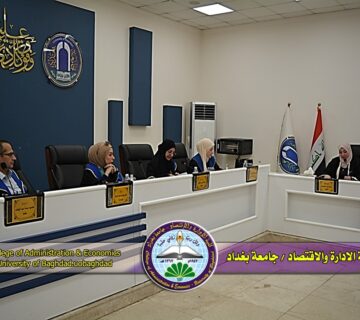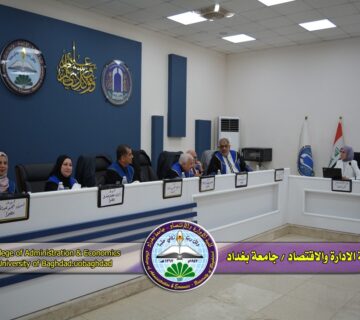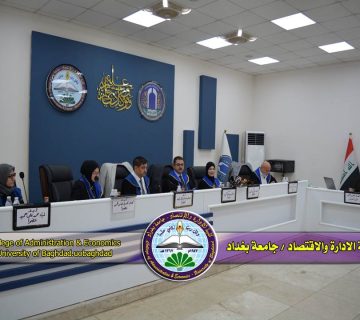

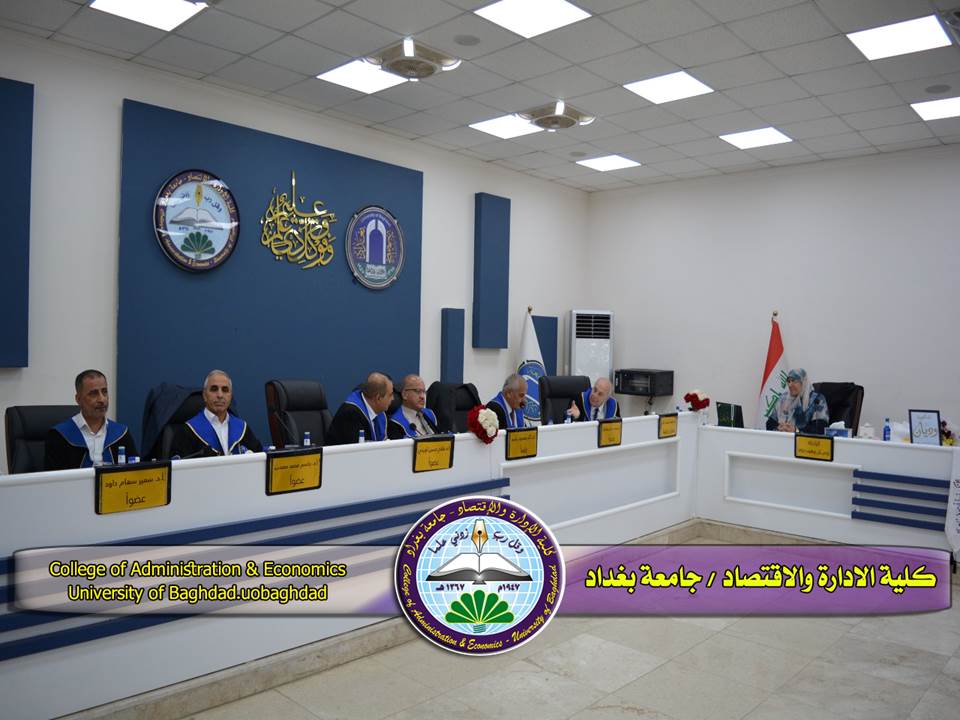
The College of Administration and Economics at the University of Baghdad discussed, a PhD dissertation in field of Economics by the student (Wedyan Whaib Jari) and tagged with (The Impact of Changes in the Central Bank’s Balance Sheet on Iraq’s Monetary Policy ) , Under supervision of (Prof. Emeritus Dr. Mahmood M. Dagher )
This thesis aims to analyze the impact of changes in the Central Bank of Iraq’s balance sheet on monetary policy, focusing on the dynamic relationship and mutual influence between the balance sheet components and monetary policy instruments in the Iraqi economy. The study utilizes annual data for the period 2005–2024, using Nonlinear Autoregressive Distributed lag (NARDL) methodology to measure asymmetric relationships in the long and short runs, Additionally, the Granger causality test is used to identify the directions of interaction between the variables.
The independent variables are the components of the balance sheet (net foreign assets, net domestic assets, currency in circulation, and bank reserves), while the dependent variables are key monetary policy indicators. The econometric results demonstrate statistically significant long-term relationships between changes in the balance sheet and monetary policy instruments, with varying strength and direction of influence across the two periods.
The results also showed that net foreign assets currency in circulation are the most influential variables in guiding monetary policy in Iraq, due to their direct link to the money supply، maintaining exchange rate stability and financing imports. Causality tests confirmed a reciprocal causal relationship between net currency in circulation and monetary policy tools, reflecting a continuous interaction between the central bank’s balance sheet and monetary decisions While net foreign assets did not appear, and despite their pivotal importance, they did not show a clear significant effect. This is attributed to the degree of control exercised by the central bank over the management of assets and its attempt to limit the reflection of their fluctuations on the economy, thereby reducing the emergence of independent effects of these variables within the econometric framework.
The study concluds that the effectiveness of monetary policy in Iraq is largely dependent on the structure of the balance sheet, particularly the dominance of net foreign assets and the monetary base ،This necessitates managing net foreign assets within a prudent and orderly framework, ensuring exchange rate stability without creating undesirable monetary expansion through reserve depletion, while reducing long-term reliance on the currency sale window as a primary tool for monetary control.