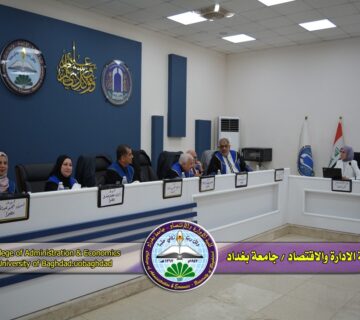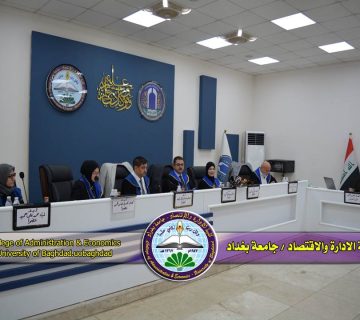
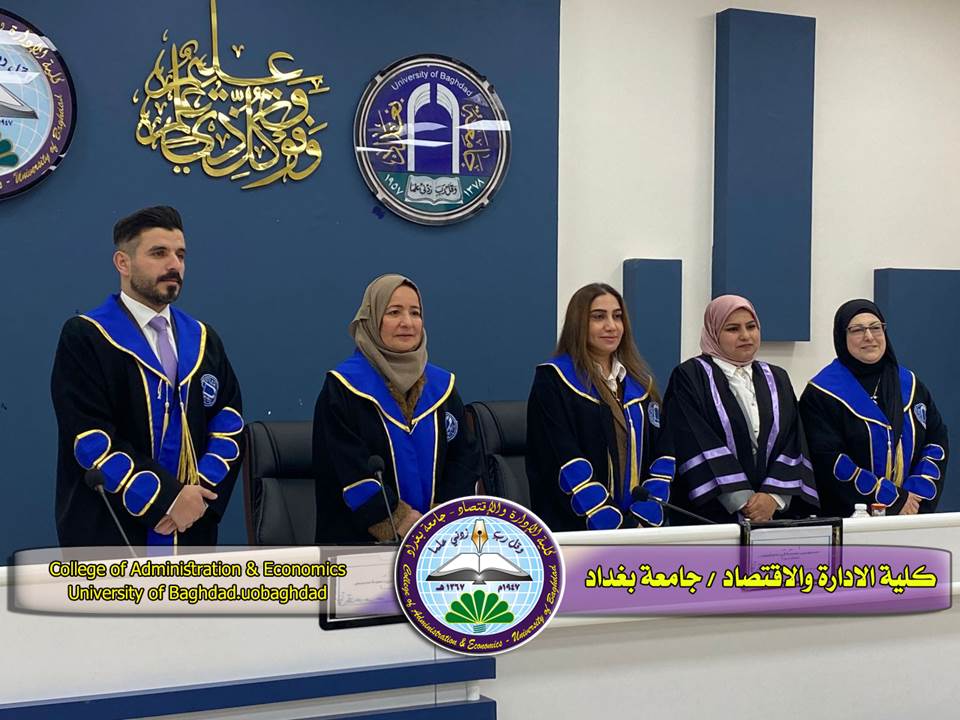
The College of Administration and Economics at the University of Baghdad discussed , a master’s thesis in field of Business Administration by the student ( Swzan Hashim Allah ) and tagged with (Developing a Proposed Model for University Performance Evaluation Based on Key Performance Indicators: A Case Study of Colleges at the University of Baghdad) , Under supervision of (Asst. Prof. Dr. Maha Kamel Jawad )
A case study was used as one of the descriptive method techniques to achieve a deep and comprehensive understanding of the studied problem, along with the quantitative analytical method as a result of applying and interpreting mathematical equations related to key performance indicators. Data was collected through field immersion with the researched colleges using official documents and records, which are actual real data collected from multiple sources (Department of Studies, Planning and Follow-up, Scientific Affairs Unit, Quality Assurance Center, Continuing Education Center, Engineering Projects Unit). The current research was applied at the University of Baghdad, selecting three colleges with different specializations as a sample for the current study, represented by (Al-Kindi College of Medicine within the medical group, Al-Khwarizmi College of Engineering within the scientific group, and the College of Islamic Sciences within the humanities group) to compare the performance of the same colleges over a specific period from 2021 to 2024, and to compare their performance with other colleges within the same university. This was done by evaluating their performance using a number of proposed indicators adopted after reviewing key performance indicators in local, Arab, and foreign universities, collecting and selecting the most appropriate ones after adapting them to the educational environment following several interviews with experts and specialists in educational institutions. These are represented by six criteria: (students, teaching staff, scientific research, community service, curricula, and infrastructure), using actual data.
The study reached a set of results, the most important of which was the absence of a unified system for performance evaluation in the colleges, which led to a clear difference in the application of key performance indicators. Al-Kindi College of Medicine excelled in most indicators, achieving the highest levels in student satisfaction, graduation and employment rates, extracurricular activities, and the student-to-teacher ratio, as well as its superiority in scientific research, international publishing, participation in conferences, community service, and providing infrastructure and green spaces. In contrast, Al-Khwarizmi College of Engineering recorded weakness in student satisfaction, fluctuation in graduation and employment rates, and weakness in publishing scientific research. As for the College of Islamic Sciences, it showed good performance in some indicators such as student satisfaction, graduation rates, and book authorship, but it suffered from weak infrastructure, outdated curricula, and limited international publishing despite its excellence in book authorship, and the absence of unified strategic plans for activities, curriculum, and academic development. These results confirm the need to adopt a comprehensive framework of performance indicators that ensures efficient evaluation and continuous improvement in the assessment of college performance