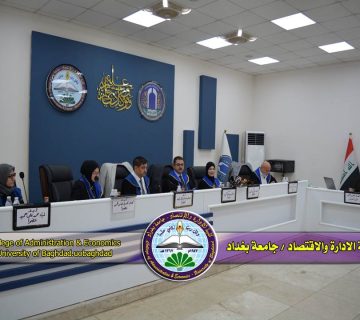


The College of Administration and Economics at the University of Baghdad discussed, a PhD dissertation in field of Public Administration by the student (Hassan Abdul-Karim ) and tagged with (The Role of Cross-Silo Leadership in Organizational Attractiveness: The Moderating Role of Organizational Resilience / An Analytical Study at the General Administration Rafidain Bank) , Under supervision of (Prof. Dr. Hussam Ali Mhaibes)
This study aimed to build and test a research model that explains organizational attractiveness in public banks through cross-silo leadership, under the moderating role of organizational resilience. This is based on the transformations witnessed by the Iraqi banking sector and the competitive environment they imposed, which has made it imperative for public banks to maintain customer trust and enhance their organizational attractiveness in the face of increasing competition.
The study adopted the descriptive-analytical approach and was conducted at Rafidain Bank/Headquarters in Baghdad. The study population included administrative leaders at various levels, with the research population reaching (197) managers. A proportional stratified sampling method was adopted; (168) questionnaires were distributed, of which (141) valid questionnaires were retrieved for statistical analysis. The study tool consisted of (53) items to measure the research variables, and data were supplemented by personal interviews and field observations. Furthermore, the study utilized a set of descriptive and inferential statistical methods, alongside structural equation modeling (SEM), to test the research model and its hypotheses.
The results revealed a significant positive impact of cross-silo leadership on organizational attractiveness. It was also found that organizational resilience plays a moderating role in this relationship, as it contributes to enhancing the strength of cross-silo leadership’s impact on organizational attractiveness. This confirms that the effectiveness of leadership practices increases in organizations that possess high levels of organizational resilience. The proposed research model proved its fitness in explaining the relationships between the study variables, thereby supporting the possibility of utilizing it in studying public organizations operating in environments characterized by competition and continuous change.
The scientific value of the study lies in providing a research model that combines cross-silo leadership, organizational attractiveness, and organizational resilience within a single explanatory framework. This contributes to enriching public administration literature and provides a scientific framework that can be utilized in future studies addressing the development of organizational performance in government institutions.