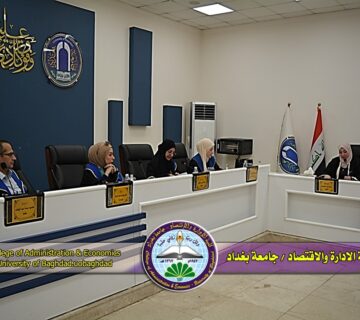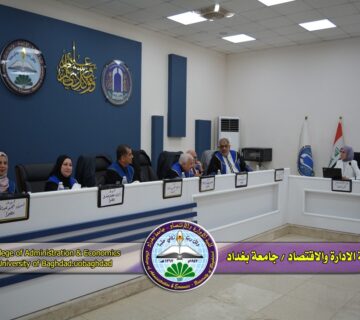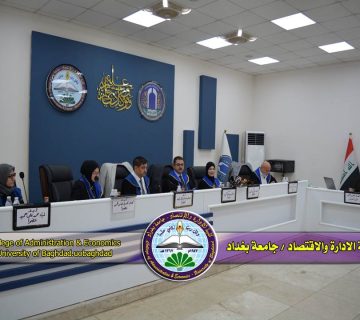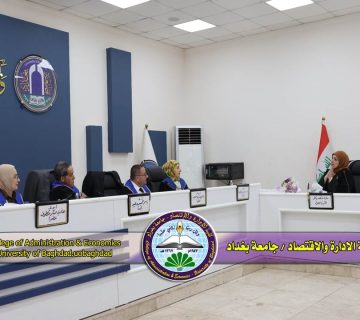

The College of Administration and Economics at the University of Baghdad discussed , a PhD dissertation in field of Accounting by the student ( Ahmed Reda Mohammed ) and tagged with (A proposed model for sustainability accounting according to the macro approach within the framework of stakeholder theory and its impact on the characteristics of sustainability information. ) , Under supervision of (Asst. Prof. Dr.Salman Hussein Abdullah )
The defining characteristic of the accounting field in the 21st century is the emergence of a new branch of accounting: sustainability accounting. This field has garnered significant attention and interest from various countries, particularly developed nations, and its application has positively impacted the performance of many international companies. Furthermore, professional accounting organizations specializing in sustainability accounting, such as SASB, have shown interest in sustainability accounting. Based on the RANKIN framework, which focuses on the four dimensions of sustainability, information is shaped and presented with greater usefulness and credibility from a macro perspective. Accounting reporting at the micro level serves as the starting point for developing useful indicators at the macro level (sectoral, national, and global). For example, specialized accounting literature has observed that environmental information reported at the economic unit level is more valuable at the macro level. Carbon accounting gathers information that indicates global warming and climate change, the indicators of which represent macro information at the industrial, national, or global level.
This highlights the research problem: the lack of a comprehensive sustainability data collection model that serves as the foundation for producing holistic information for stakeholders whose focus has shifted under the holistic approach, becoming global and requiring comprehensive rather than partial information. The research employs a deductive methodology to illuminate concepts related to the research variables, as well as an inductive methodology to assess the current state of sustainability reporting in the Iraqi economic units included in the research sample, using the indicators of the proposed model. This aims to arrive at results that can be generalized to all economic units.
The research problem lies in the absence of a comprehensive sustainability data collection model that serves as the basis for producing holistic information for all economic units. The study reached a number of conclusions, most notably that there is a weakness in the economic units in the research sample regarding the reporting of sustainability accounting dimensions according to indicators. The analysis revealed that the research sample was weak in its reporting of the dimensions of sustainability accounting (economic, environmental, social, and governance). Furthermore, the study highlighted the broad scope of issues covered by sustainability accounting reporting, which may be of significant importance to stakeholders within the economic unit. In other words, the move towards sustainability requires new ways of doing business, different organizational management styles, and even new economic models. Therefore, sustainability accounting includes new methods and information that differ from what is found in traditional financial statements and which were not considered in the decision-making process. These include environmental impact, social impact, cultural impact, innovation capacity, customer satisfaction, knowledge management, quality management, cultural heritage assessment, and others.
Several recommendations were also made, the most important being the need for those responsible for regulating accounting in Iraq to utilize the economic variables identified in the study when formulating a model and determining the level of state intervention and its role in economic activity. This is crucial for determining the impact of each of these variables on shaping future model directions. The need to carry out radical reforms on various political, legal, economic, educational, cultural and organizational levels by enacting laws, instructions and guidelines and introducing them into educational curricula in order to create the appropriate environment required by the process of implementing the requirements of sustainability accounting.