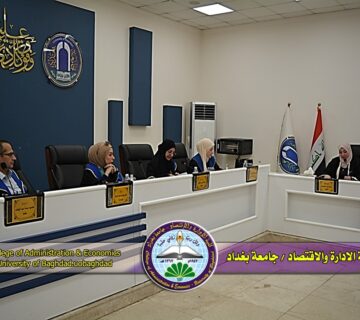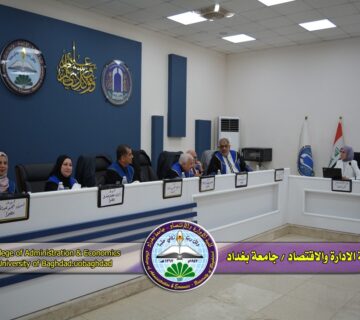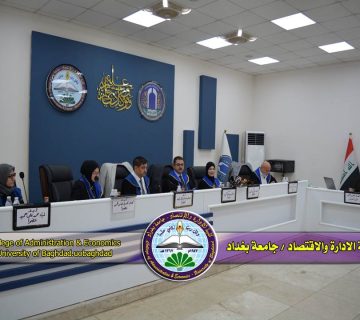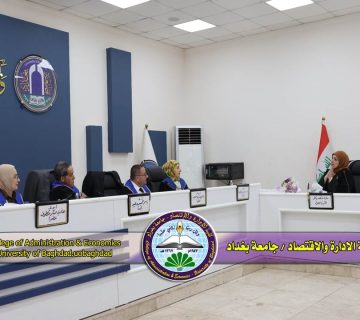


The College of Administration and Economics at the University of Baghdad discussed , a PhD dissertation in field of Accounting by the student (Mohammed Gazi ALIAS) and tagged with (Activating financial and administrative control systems using IFMIS and its impact on the quality of the government financial reporting system in Iraq- A proposed model ) , Under supervision of (Asst. Prof. Dr.Safwan Qusay Abdalhaleem )
Many governments have sought to activate their control systems by replacing traditional information systems, which rely on paper records or separate computer programs for collecting, processing, storing, and retrieving data, with integrated and interconnected electronic information systems. This shift aims to improve the quality of the financial reporting system in producing both financial and non-financial information. The Integrated Financial Management Information System (IFMIS) is one such electronic system. Many governments have widely accepted it due to the control features it provides, as well as its automated, secure, and integrated information environment for financial and administrative operations. Moreover, it enables the rapid transfer of data and information among the departments of government units on the one hand, and between government units and the Ministry of Finance on the other.
The current study aims to examine the possibility of activating financial and administrative control systems through the use of IFMIS and its reflection on the quality of the governmental financial reporting system in Iraq. In its theoretical and analytical aspects, the study relied on identifying the nature of the research variables and analyzing the relationships among them. In the practical aspect, the study relied on collecting the opinions of officials in the departments and divisions of the headquarters of the Iraqi Ministry of Finance through a checklist, as well as analyzing the reports of control systems to identify the problems facing financial and administrative control systems under the use of traditional information systems. A questionnaire was also used to examine the possibility of activating financial and administrative control systems through IFMIS and its reflection on the quality of the governmental financial reporting system in Iraq through accountability and transparency. This was achieved by collecting the opinions of a sample of academics in accounting departments at Iraqi universities, as well as professionals, including accountants and auditors working at the headquarters of the Ministry of Finance. The study also developed a proposed model for improving the quality of the governmental financial reporting system in Iraq considering the findings reached.
The study reached several conclusions, including that financial and administrative control systems in the Iraqi public sector suffer from numerous problems under the use of traditional information systems. These problems include the high frequency of errors in recording financial and administrative transactions, the difficulty of monitoring assets, delays in preparing financial and non-financial reports, and the difficulty of protecting information from manipulation. Financial and administrative control systems can be activated using IFMIS due to the features it provides, including electronic controls that reduce errors, the ability to monitor assets instantly and continuously, the ease of preparing reports through the availability of a unified database, and the use of cloud technology to preserve information. These features would have a significant impact on the transparency of financial and administrative operations and on the ease of accountability and verification, thereby improving the quality of the reporting system in the Iraqi public sector in producing financial and non-financial information. Furthermore, IFMIS has a direct and significant role in improving the quality of the governmental financial reporting system by facilitating the adoption of the International Public Sector Accounting Standards (IPSAS), supporting the use of the accrual basis of accounting, facilitating the adoption of program and performance budgeting, and enhancing the qualitative characteristics of accounting information.
The study presented several recommendations, most notably the need to begin the steps required for adopting IFMIS in the Iraqi public sector because of the effective features it provides. These features contribute to activating financial and administrative control systems, which would positively affect the improvement of the quality of the governmental financial reporting system by supporting accountability and enhancing transparency. The study also recommends establishing mechanisms for transitioning from the current governmental accounting system to the International Public Sector Accounting Standards (IPSAS), adopting the accrual basis of accounting, and implementing program and performance budgeting before initiating the use of IFMIS, to improve the quality of the governmental financial reporting system in Iraq. In addition, the study recommends completing the implementation of the Treasury Single Account (TSA) system and linking it with the electronic payment and collection systems, GPOS/GPS. Most importantly, the implementation of these systems should be associated with the use of IFMIS, given the high degree of integration, interconnection, and mutual influence among these systems, to activate control and improve the quality of the financial reporting system in the Iraqi public sector