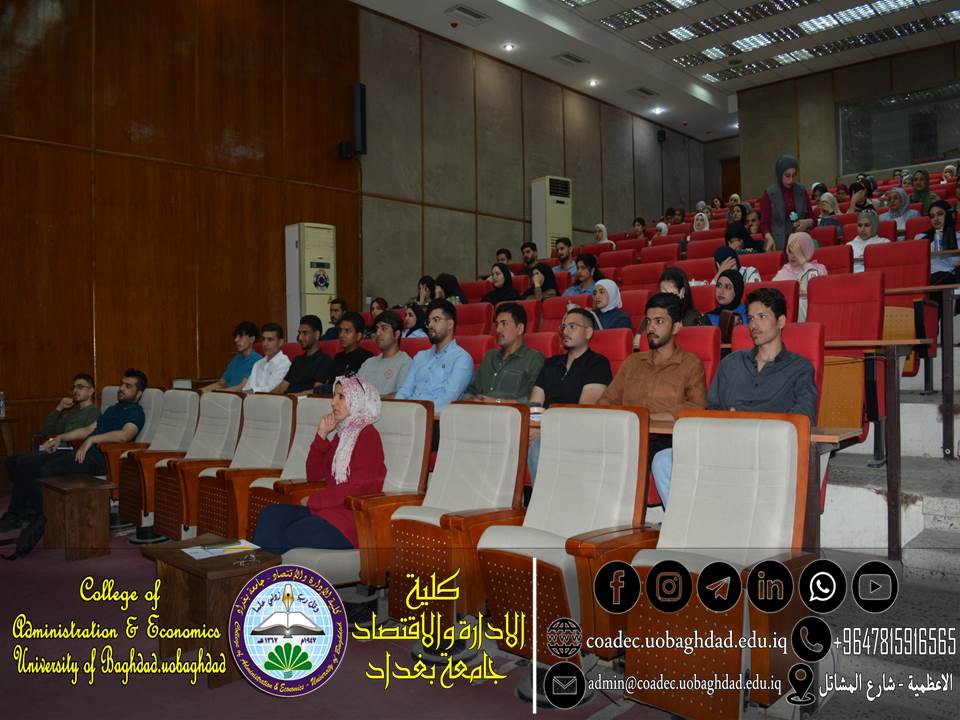

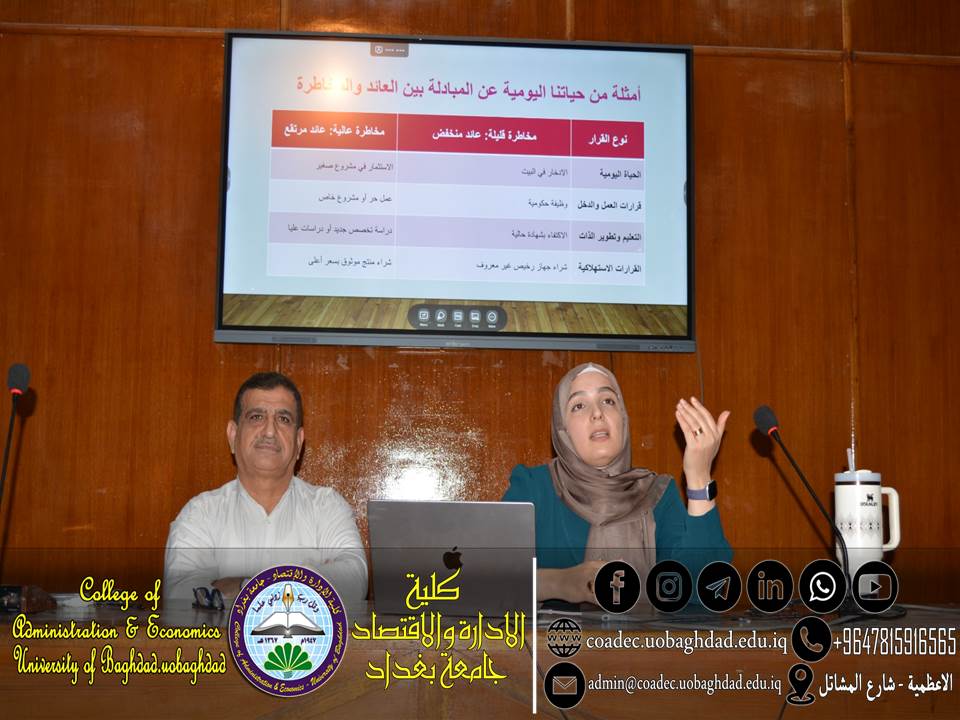
The Continuing Education Unit, in collaboration with the Department of Business Administration, organized a specialized workshop entitled “Risk–Return Tradeoff: Financial Lessons for Everyday Decision-Making.” The workshop was delivered by Assist.Prof.Dr. Iyad Taher Mohammed and Assist.Lect. Fatima Faisal Kadhim, with the attendance of a number of faculty members and students interested in financial and investment matters.
The workshop aimed to provide a comprehensive overview of financial management and personal finance, culminating in an in-depth explanation of the positive relationship between risk and return. The presenters emphasized that “the pursuit of higher returns is inevitably associated with a higher level of risk,” while outlining the theoretical foundations for measuring risk (systematic and unsystematic) and calculating returns.
The workshop addressed several key themes, most notably:
– The time value of money and the impact of inflation and uncertainty on financial decision-making.
– Types of financial risk and methods of measurement using variance and standard deviation.
– Balancing risk and return as a fundamental mechanism for rational investment decision-making.
– Practical real-life examples, including investments in stocks, small businesses, real estate, gold, education, and bank savings.
Additionally, the workshop provided practical guidelines on effective saving strategies, including setting savings goals, preparing a personal budget, rationalizing expenditures, and utilizing appropriate saving instruments, with an emphasis on the importance of periodic review of savings plans.
At the conclusion of the workshop, the presenters recommended enhancing financial literacy among students and the broader community, and fostering an investment culture grounded in a sound understanding of risk prior to anticipating returns. Such an approach, they noted, contributes to sustainable financial resource management and supports the achievement of personal and professional objectives away from random or unstructured decision-making.