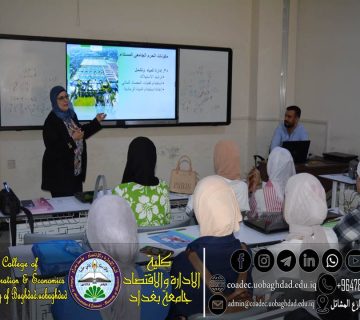

Professor Dr. Sanaa Abdul Rahim Saeed Al-Abadi, a faculty member in the Department of Business Administration at the College of Administration and Economics, University of Baghdad, conducted a specialized training course entitled “Strategic Planning in the Management of Courts and Government Institutions” at the Judicial Institute. The course was attended by 24 employees representing a number of ministries and state institutions and was held over the course of one week.
The course was organized as part of the Judicial Institute’s efforts to strengthen institutional capacities and promote a culture of scientific planning, thereby contributing to the improvement of administrative performance and enhancing the efficiency of government institutions. The course’s academic program focused on several key areas, including:
- The concept of strategic planning and its importance in improving institutional performance.
- The stages involved in developing strategic plans, as well as mechanisms for their implementation, monitoring, and evaluation.
- Modern practical applications that enable participants to connect theoretical knowledge with practical realities in the workplace.
The course also highlighted the role of strategic planning in improving the management of courts and government institutions and enhancing their ability to address challenges and make evidence-based decisions, in line with the requirements of administrative development and institutional governance.
The course aimed to enhance participants’ knowledge and skills in strategic planning, as it is regarded as one of the most important modern management tools used by institutions to define their future directions, establish priorities, and utilize their resources efficiently. This, in turn, contributes to achieving institutional objectives and enhancing the quality of services they provide.
It is worth noting that the course contributes to the achievement of several Sustainable Development Goals (SDGs), including:
- Goal 4 – Quality Education: The training course represents a model of continuing education and skills development, contributing to improving the quality of human resources and enhancing the outcomes of education and professional training.
- Goal 8 – Decent Work and Economic Growth: Improving the administrative performance of government institutions contributes to enhancing the work environment and increasing the efficiency of services, which positively supports sustainable economic growth.
- Goal 9 – Industry, Innovation and Infrastructure: Adopting the latest concepts and approaches in strategic planning promotes innovation in public administration and supports the development of more efficient institutional structures.
- Goal 16 – Peace, Justice and Strong Institutions: Strengthening the capacities of judicial and government institutions through strategic planning contributes to building strong and transparent institutions capable of promoting justice and good governance.
-
Goal 17 – Partnerships for the Goals: The participation of employees from multiple ministries and institutions reflects the importance of institutional partnerships in achieving sustainable development through cooperation and the exchange of expertise.